


The People And The Machine
For the first time, Roman Sterlingov writes about the abuse he’s experiencing in prison, and what it means to lose your privacy – to those who are incarcerated, and to those living freely in society.

Roman Sterlingov is currently serving a 12.5 year prison sentence for allegedly operating the early bitcoin mixer Bitcoin Fog, gaining publicity in a case that "put cryptocurrency tracing on trial". A hearing for his appeal is scheduled for May 12th, 2026. Read more about his case here.
"They can take all your ramen soups and socks, Roman, and lay you down on a concrete floor without a mattress, and they can strip-search you 3 times a day, but they cannot do anything to your mind," he said. Tom was leaning against a railing as angrily yelling inmates in depressing ugly overalls were buzzing around him, helplessly cursing empty threats against the guards. We had once again been gathered in a large, damp, bare-floored brick hall where we would spend the excruciating rest of the day.
Our regular cell was being "shaken down." The process involved throwing all of our personal items on the floor, going through our bunks, taking our things, such as any piece of white bread that we might have saved for the hungry evening, a leftover snack from the previous day, the affectionately named "cat food" Tuesday. However, the hungry were perhaps not in the worst position, not compared to the cold, most of whom would lose their extra blankets and possibly their paid-for t-shirts. I was both cold and somewhat hungry, but mostly I was worried about which of my books would forever disappear. We had been allotted a generous limit of 2 books per person, which was itself yet better than the previous year of having no books at all.
It was quite a long road from me, just wanting to trade some Bitcoin back in Sweden. I got introduced to it when I was going to some of the earliest meetups in Europe and was surprised by how inclusive this community was. We had no agendas or pretenses, I was just a guy with a laptop, excited about a new technology and meeting all the various incredible people that were coming to such wonky things around 2011.
I would come not so much for Bitcoin, which nobody really understood at the time anyway, but because while sitting at a bar with a bulky laptop and dictating alphanumeric addresses to each other and trading some of the first crypto transactions in the world, it felt like the future; like we were early onto something great. I could talk to professors on obscure topics, economists, engineers, people with strange ideas.
To most of them, it was a potential tool of freedom, of liberation. I didn't pay enough attention at the time, but people kept saying that this technology is very needed because people in many places in the world are getting abused and persecuted and this technology has a chance to help against the abuses of power. Their warnings seemed very distant, and I didn't understand how a technology of freedom could be perceived as a danger to the powers that be.
But in an ironic twist of events, here I was, at a different sort of meetup, listening to Tom, — somebody I met along the way, stuck in the same straits, as he was trying to make me feel better with his wisdom. He didn't seem phased by another meaningless shakedown, even though it was clearly not going to change the safety situation, nor the number of fights, but was, instead, performed to instill fear and dispel any resemblance of basic sense of humanity.
"This is it, this is their limit. This is about as miserable as they can make your life. But they are still powerless to really do anything to you, not to your mind. This is why they are trying so hard."
What a cliché, right? Read this advice in some book and it might sound like a fortune cookie, or a bumper sticker. Except that I've found that it only sounds like cliché when you are not actually in it, when you live a nice comfortable life, lucky to never need it.
But when your elbows are deep in the mud, when one day sounds like a very long time to successfully get through without breaking down, because you are completely disconnected from your family and friends, without any genuine human connection, force-fed old baloney and loudly yelling sports channel all day until you ears ring, and you don't know anything about what's going on, then certain words reveal some of their real meaning, their sacred resonance. When you feel like a conspiracy of psychopaths are pulling out block after block from the shaky "jenga tower" of your sanity, when they are mounting a 51% attack on your mind, a fellow experienced traveller might just help you out and put back the most important piece and change the algorithm so-to-speak, add a bigger vision of the higher purpose.
 L0la L33tz
"A life lesson so true that your dog probably knows it."
I already knew, of course, that this is how all good spiritual coaching works. Before the point of transformation is when all real insights, no matter how profound, sound like clichés, like clickbait from a charlatan with a newsletter who is about to ask for money.
Later, well after the transformation, looking out from the new reality, then it all sounds like banal, self-evident, inalienable truths, established well beyond any reason for repetition. A foundation laid and long ago settled. A life lesson so true that your dog probably knows it.
All the more interesting however is that magic window in between, when words turn into spells, when they drop, like a seed into prepared soil and start the growth of a whole garden. Somehow the mind's bootloader is unlocked and we can execute a one-sentence command that leverages and unpacks a year's worth of struggles and inner work. A new reality update drops, older dysfunctional views burned off and rendered impossible. This is more the sort of work I was really into.
How do these moments happen? How does one catch this moment? How can someone find words like these, especially in miserable places like where I am now?
The strangest part is that the best thing I have so far experienced about these jails is the people. In the most unexpected circumstances there would be someone who tried to support me and help other people around them.
How could that be? Where do they come from? Supposedly, the worst parts of society are here, all found and gathered together in a confined space, in this repository of maladapted characters, the most recherche form of misery.
And boy, those guys are all really here too! Don't get me wrong, the worst part may indeed also be the people — because they didn't put me into a white-collar camp with doctors and lawyers. Over the past 5 years they dragged me through the various jails and prisons which are a whole other ordeal altogether, designed with extra viciousness in mind. The most broken psychopaths do some of their best work in places like these. And then there are the inmates... People that go by names like "school shooter", "trashcan", "aids", "stray dog", "rabid dog" and various other dogs. People who will readily beat up an elderly cellmate to steal their ramen soups, or who have out loud conversions with voices in their heads, apparently those of their victims. Murderers, rapists, violent people who will yell and fight all day, all the refugees from the overwhelmed and largely shut down mental health system.
You would think that in any reasonable situation, any other white-collar offender without any criminal history or any identifiable victims would inarguably go to a camp, or home confinement. But I was also denied bail, as if I was some dangerous terrorist.
It's only months later that Tor, my lawyer, told me, "from in here you can't possibly sift through the heaps of thousands of pages of documents they said they ‘might’ try to use against you. It's done so that you can't prepare a real defense properly, I've seen this in many cases."
The next time I saw him, on the following visit, he was behind a wall of thick security glass, his palm pressed against it, talking to me through a black phone receiver handle. I knew him well enough at that point to know he put his hand on the glass ironically, but it still made me feel better. However, he was not even able to give me a single sheet of documents to examine. He said that the jail had just made up some pretense and was now refusing to even let me see him in person anymore on any future visits.
At that point I stopped believing in coincidences.
L0la L33tz
"What are we supposed to learn?"
This is a situation where even a few bad apples can seriously poison life for everybody, and the good people working in the system can't always remedy. Doing a necessary job is one thing, but what about enjoying it? What about going above and beyond? What about forgetting it's just a job? Banalities like beatings, unnecessary lockdowns without shower — yes, but what about screaming and howling animal noises over the loudspeaker at 3 am every night, playing full-on Lord of the Flies, to terrorize and to not let any inmates sleep? What do you make of that? Paint a psychological profile.
In such environments, in a system designed to punish and perpetuate — not recover and heal, how does anyone stay a normal person? And does our society have a chance if such abuses are still happening? What is even the point of this crazy experiment? What are we supposed to learn?
"Do you remember we were talking about the illusion? The decorations will keep rotating, but the fight has always been the same. You need to not get distracted. This is just a magnifying glass for what's inside."
"Inside of me?"
"Of you, of me, of us all, the society..."
Tom's words hit me like a final, deepest round of a Wim Hof breathing meditation session: what we have experienced is not just some brutish barbarian hate, this is much more nuanced and does not just happen in here. This place is like an incubator for people's best and also worst qualities and neuroses.
Sometimes when scientists find a new germ, they will put it into a special nutritious environment so that all of its properties and weapons and spike proteins will have a chance to develop and come out and be studied while it thinks that nobody is watching.
A dark, hidden thirst for power, a drive that, out there, in society, is restricted by the leashes of civilization, might subtly manifest itself as a harmless foible or fetish, — yelling at a TV or cussing off somebody in traffic... But in here, under corrosive pressures of corrupted, unrestricted, unhinged power, that thirst is attuned and amplified, and comes out in full. It's that same thirst, the one I could see in bloodshot eyes of a guard punching away at a paraplegic, for not getting out of his rickety wheelchair and trying to show the chair to his judge. (I can only tell you about distant and anonymized examples from previous jails right now, of course, in fear of immediate retribution. But you can easily find specific instances of abuse online, including in my case.)
One group of people is stripped completely of all their rights and humanity, while the other is given an unrestricted unpunished power over the first one. In here the monsters don't have to hide themselves and their fangs in such a system.
One of the most curious things I've been seeing in this incubator, in this clean-room experiment, is what happens to our privacy as the abuses of power in a facility ramp up. We don't have a lot of privacy to begin with, of course. Some of it is dictated by security requirements and procedures. But it's when it goes well beyond that, starts being more creative and personal, — that's when it opens a window into something much darker.
When a certain guard starts going through people's family photos, or grabbing their letters and reading them, commenting on the pictures as the guard is walking by, or lurking around when people sleep or go to the showers, it's always a canary in the coalmine, foreshadowing harder abuses that are about to come.
Keonne Rodriguez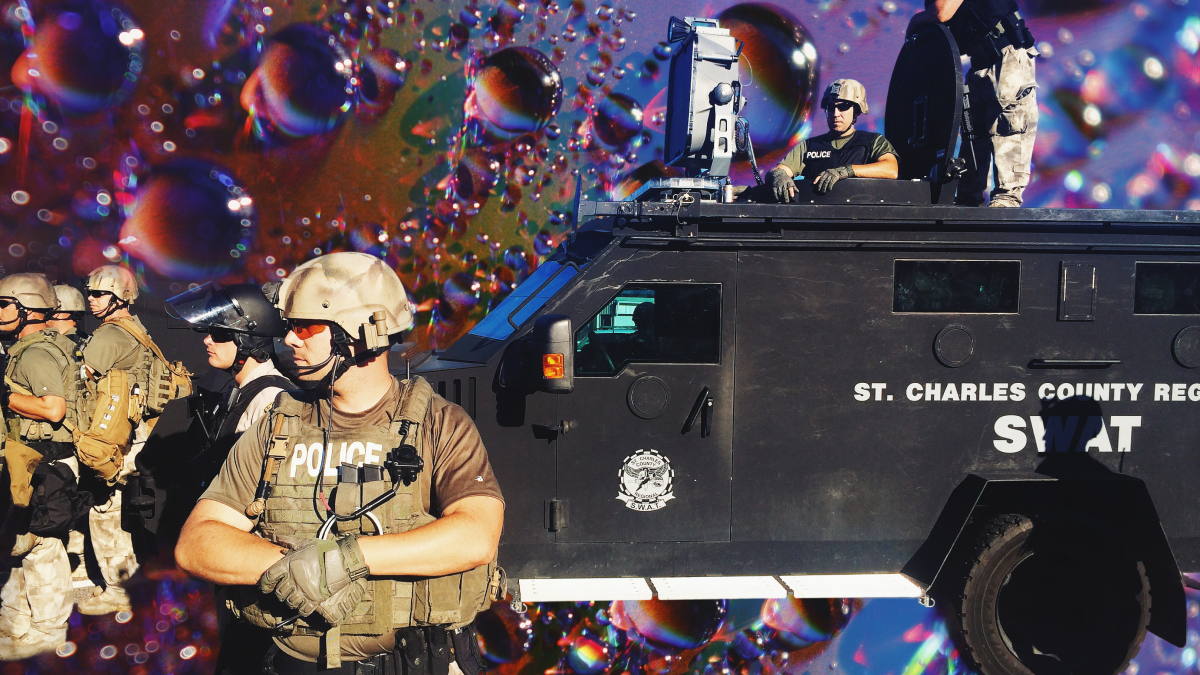
"Legitimate privacy is almost the only fundamental defense we have against the machine exploiting our weaknesses and lives for its own purposes."
It would do us all good to not read too much into an isolated sadist falling through the cracks here and there, if they were already coming in this way. But have you ever watched how the machine eats somebody's soul?
A fresh officer comes in, after several whole weeks of required training, and at first he treats everybody like a human being: not doing any favors of course, just respecting the situation. And every once in a while there will be an occasion that will test them. Their boss might tell them to go move an inmate from cell to cell and there he will have a choice to either simply move him or get invasive, throw out a few family photos, not let them dress fully, rough them up a bit, interrogate them...
As the guard succumbs to the temptation, his boss is watching, approving. At the end of the shift the boss cracks a little loaded joke, perhaps humor, perhaps a powerful signal, when composed with a subtle nod, an accent, an invitation. "I knew you were one of us, sometimes we need to go outside the rules to put the screws on these animals."
And there it is. A few more months of this weaning and the same guard comes into all his shifts swinging, yelling, provoking, every day looking for an excuse to make somebody's day miserable.
Just like with the "ring of power," the moment they put it on, the all-seeing eye of the machine sees a new prospect and comes for them. The ones addicted to power, having gotten that little teaser of unhinged power, they can't turn back.
The proverbial line between good and evil goes through the heart of every state and federal agent and officer in the country, all 500 thousand of them, all the people who have unchecked power (in various degrees of course). I wish I was able to say that they all are saints and that this power is in good hands. But as of now, the machine is very good at finding weak ones and breaching that line, plucking that string and playing it to its own tune.
Legitimate privacy is almost the only fundamental defense we have against the machine exploiting our weaknesses and lives for its own purposes. Its interests will always be at odds with our privacy and it will always try to take more and more of it away. If you don't stop it, it will take all of it.
Look at what's happening out there. We in here have no privacy, sure, but are you that much better off? People walk around with their spyphones tracking their every twitch, every blink and every millisecond spent swiping each post. Big data companies know everything about them, the chatbots are tracking their every conversation and thought. You now have AI at the level of some operating systems, built in, turned on and recording everything you are doing, screenshots and all, building a profile that is analyzed, fingerprinted and sold to the highest bidder.
L0la L33tz
"If your every idea, before even being fully born and having started living, is invasively read, seen and owned by somebody else, if you are therefore afraid to think freely or speak outside of the central signal imposed on you by the mainstream media, then you won't think any new ideas."
We seem to be prone to forgetting why we have privacy in the first place. It should be easy. Any man who has lived with 60 other men in the same room 3 feet apart knows this as a completely natural human need. But so does anybody who grew up in a small house with siblings, anybody who ever had a fence around their house; anybody who had a rumor about them spread at a workplace or private pictures leaked out. Also anybody who ever voted in a democracy.
If your every idea, before even being fully born and having started living, is invasively read, seen and owned by somebody else, if you are therefore afraid to think freely or speak outside of the central signal imposed on you by the mainstream media, then you won't think any new ideas. And if nobody thinks of new ideas, then the whole thing collapses. It is not some whim, it's a pillar of the western civilization.
We all recoil when privacy is infringed, because we instinctively know that before taking away our rights and liberties the machine will start with our privacy. It's an early warning system, our attempt to prevent a very subtle failure mode that our machine always goes into, the "totalitarian bonanza at expense of regular people" failure mode. We always seem to end up there, it hits us too late, sneaks up on us like on an unsuspecting frog in a pot of water set to boil. The learning function for this failure has no gradient that we can feel out easily, the feedback loop is not continuous and the error signal does not propagate back fast enough, its sharp edges keep cutting us, taking us by surprise.
Or maybe it's because knowing our weaknesses, they employ manipulative attacks, targeting our emotions and feelings. They try to associate privacy with certain emotions, like a feeling of guilt for just using legal anti-surveillance tools, or open source software. It has come to absurdities like calling simple installation of a free, libre OSS app on device you own "side loading," like you're doing something illicit, something shady...
When this is realized to be nonsensical and fails, they try to imbue feelings of despair and futility, that all our efforts are useless. They want to be in your head when you turn on your computer and your hand reaches for the vpn button. They want fatigue there, they want you to feel hopeless, to think, "what's the point? They have all my data already, and I'm not doing anything illegal anyway, so why bother?"
If we can't see past the walls of the pot with the boiling water, if the gradient doesn't work, then maybe we need more examples. It's interesting because that's what the government said when they gave me a 12.5 year sentence (they wanted 30!), — both being many times longer than what criminals get for stealing or defrauding hundreds of victims and putting people's lives in danger. The government openly said that the sentence was for "general deterrence" — a euphemism for making an example of somebody, a tactic usually more popular with other types of organizations.
As far as examples go, it sure felt like a surreal one, but it all really happened. They told me they are going to ruin my life, separate me from everyone I love, waste a decade of productive time, so that some other criminals somewhere would be deterred in the future.
They said I was in conspiracy with literally every criminal on the internet, people I've never met or talked to... They demonized technical knowledge and interests, like using Linux or having "highly unusual devices" like raspberry Pis and too many old useless sd cards. They said I was using wifi paint to thwart some investigations and other bizarre things...
Whether you see this as an example of deterrence or an instance that shows that abuses of power can happen to anyone in the community, is not up to me. All I can do, like every other normal person, is to try to control the examples that we chose to be. I try to help people around me, spread the knowledge about my experiences and how do deal with them, help people with their mental health and navigating this crazy game.
I've now seen the insides of the machine and how it can abuse people to justify itself. How it uses technology and creates false narratives to sustain itself.
So whether you are reading this because you want to fight injustices and abuses of power, or just simply want to be left alone and create and do things you love, I think that it all starts on the inside, with recognizing the forces that live in all of us and how they play into the technology, the machine and the surveillance.
For whatever reason, I've been thrown into the epicenter of this fight, and I would be happy to keep telling you about it. If it helps anyone out there, then maybe something good can come out of this.
This is a guest post by Roman Sterlingov. Opinions expressed are entirely their own and do not necessarily reflect those of The Rage.
Independent journalism does not finance itself. If you enjoyed this article, please consider making a donation. If you would like to note a correction to this article, please email corrections@therage.co
