


Vegas 2026: The DOJ's Developer Exemptions
In one of the most anticipated talks of this year's Bitcoin Conference, Todd Blanche promised developers would no longer be targeted – with an important caveat.

"It's great to be here," said Acting US Attorney General Todd Blanche, addressing the audience at Bitcoin Vegas' industry day yesterday afternoon. Blanche, as well as FBI Director Kash Patel, were invited on a panel hosted by Coinbase Chief Legal Officer Paul Grewal to discuss "Code as Speech: Ending the War on Bitcoin."
The hypocrisy of hosting Blanche on a panel about code as speech and the end of the war on Bitcoin raised several eyebrows over the past week on social media. Last year, the Department Blanche now leads sent Samourai Wallet developers Keonne Rodriguez and William Hill to prison for close to a decade combined, and secured a conviction of Tornado Cash developer Roman Storm, preparing for a retrial on the remaining two charges this coming October.
In just over a year, Trump's DOJ has sought – and continues to seek – to lock three non-custodial software developers away for half of a century combined. But developers need to fear not, Blanche proudly proclaimed. As long as they don't know that their software is being used for illicit activity.
This stated exemption continues to intentionally leave the door wide open to prosecute non-custodial developers.
 L0la L33tz
DOJ Will Still Prosecute Developers
"We're no longer going to regulate by prosecuting," Blanche said yesterday. "Which means quite simply that if you are a developer, if you are part of a platform — whether it's in the United States or elsewhere — we are not going to take your liberty away and prosecute you when there's not even a developed regulation that points clearly to a law you're violating, or some maxim you're violating."
"The basic principle is this," Blanche continued. "If you are developing software, if you are a coder, if you were part of that process — and you are not the third-party user, and you are not helping and knowing that the third party is using what you develop to commit crimes — you are not going to be investigated and not going to be charged."
These facts matter, Blanche added, "because if you're laundering money or violating sanctions, the mere fact that you happen to be a coder doesn't excuse you from criminal liability." The issue with this exemption should be glaringly obvious to anyone who has followed the DOJ's previous prosecutions of non-custodial developers.
"The real question is where DOJ draws the line between publishing noncustodial software and 'helping' or 'knowing' about a bad user," writes Coin Center CEO Peter van Valkenburgh on X. "What counts as 'helping'? What counts as 'knowing'?"
To Prison via Email
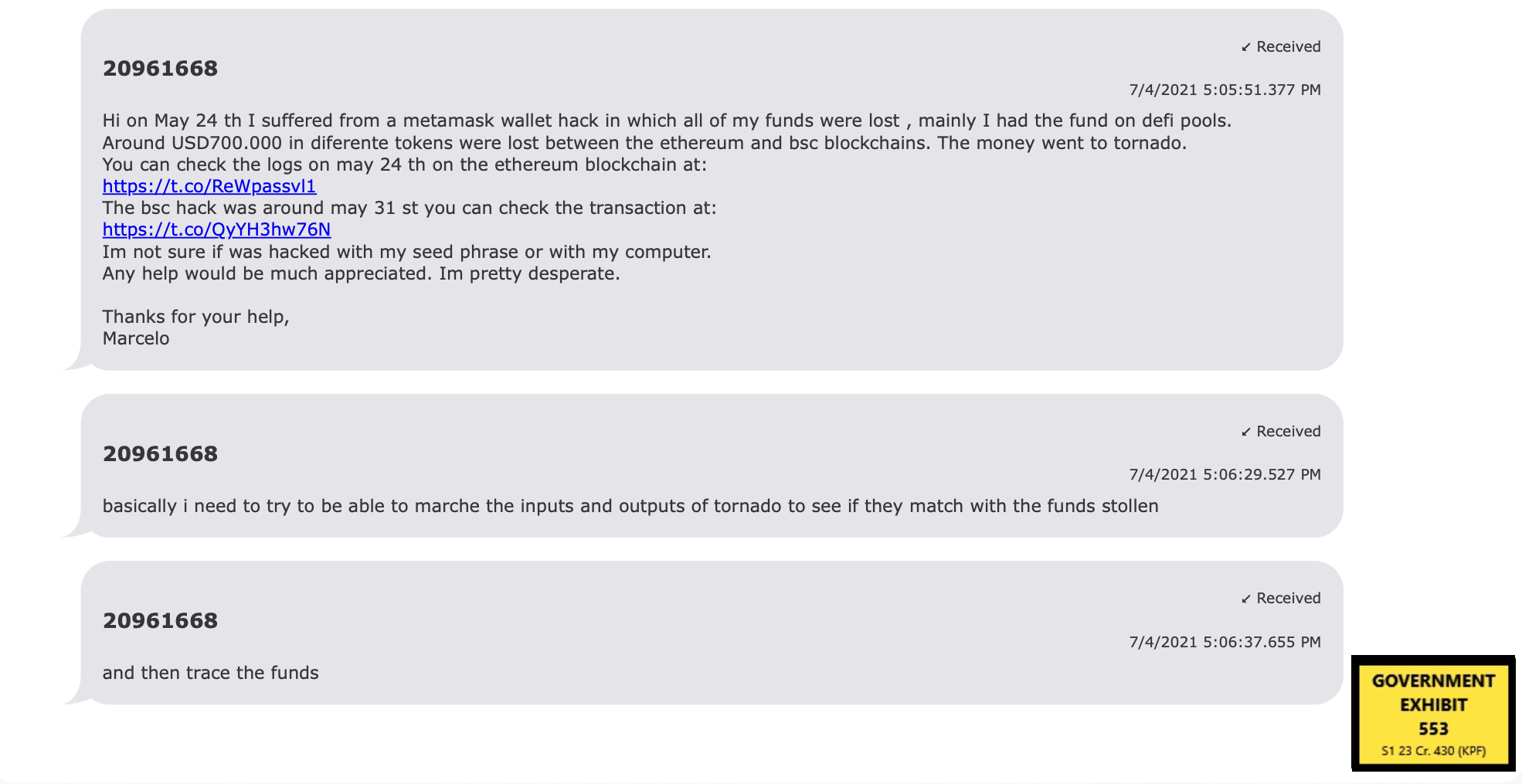
In the case of Tornado Cash developer Roman Storm, the evidence introduced by the Government as "knowing" that the software was used by criminals suggests that receiving emails by third parties on the alleged misuse of software creates criminal liability for the developer. Additionally, the Government introduced excerpts of Storm's Google searches on prominent hacks, as well as the sharing of concerns over media reports on said hacks with team members.
In the criminal case against alleged Bitcoin Fog operator Roman Sterlingov, "knowing" constituted a single email sent from a federal officer to the Bitcoin Fog service inquiring about laundering money stemming from illegal MDMA sales.
"Translation: 'If you're operating a non-custodial bitcoin service, a federal agent will send you an incriminating email ('Hi dude, I would like to launder money with your service...') and it will be considered as a 'fact' against you," writes Laurent Salat, formerly of 0xt, on X.
As Judge Failla argued at Storm's hearing for acquittal, merely knowing that your software was being misused by bad actors was likely not enough to constitute criminal liability by existing legal standards.
"If what you're saying is that merely keeping the business afloat while knowing that it was being used for bad purposes, that that's enough for criminal liability, then tell me, but I'm concerned if that's your theory," she told the prosecution earlier this month.
Anna Baydakova
When Indictment?
The other question that consequentially arises from Blanche's argumentation is what a developer is supposed to do once they become aware that their software has been used for illicit activity.
Is it enough to step away from the project? Must the software be stoppable? Does criminal liability arise regardless of a developers action following awareness?
"When should he have walked away? Nobody knows," Storm's counsel Brian Klein told the court. "That's a core issue here, your Honor, that we have to address."
Any technology created for legitimate purposes can be misused, and founders knowing about such misuse and still developing their products is not enough to accuse them of assisting criminals, Klein insisted, as his team presented various case law to back up their argumentation, such as a sugar seller who knew that his product was used to manufacture illegal alcohol in the prohibition era.
What's worse is that the DOJ appears to continue to hold on to its theory that non-custodial developers transmit funds on behalf of others to form the basis for criminal liability under current money transmission laws. As AUSA Ben Arad argues: "Is he not engaging in unlicensed money transmitting? Of course he is. He's transferring money from one place to another."
"DOJ cannot credibly claim it has ‘changed the game’ while still prosecuting Roman Storm. The precedent SDNY is trying to set is wholly at odds with Blanche’s memo and the President’s policies," Storm counsel Keri Axel told Eleanor Terret of Crypto America following the panel.
If a criminal conspiracy would merely arise from "knowledge" of an illegal act, any email sent to developers containing knowledge of illicit activity would create criminal liability for the actions of other people.
This, in essence, is what Blanche is arguing – and it would mean that anyone developing non-custodial services could go to prison for decades to come.
Independent journalism does not finance itself. If you enjoyed this article, please consider making a donation. If you would like to note a correction to this article, please email corrections@therage.co


