

Emails Reveal Jeffrey Epstein Money Financed Bitcoin Core Development
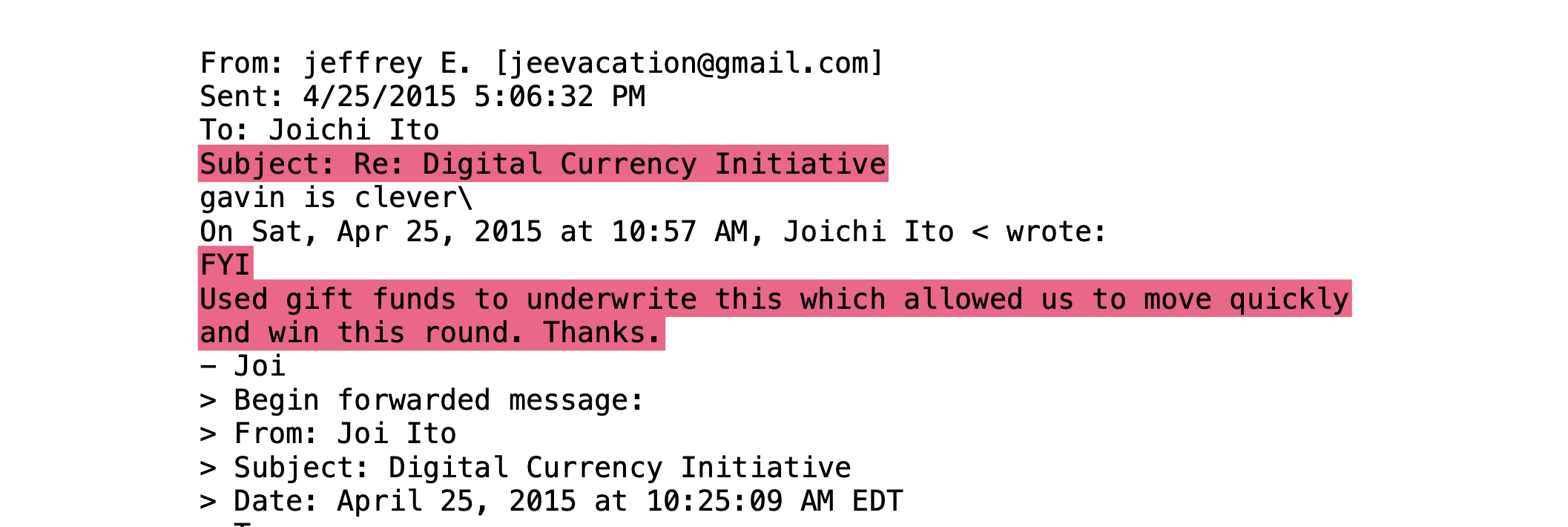
“Used gift funds to underwrite this which allowed us to move quickly and win this round. Thanks,” former MIT Media Lab Director Joichi Ito wrote Epstein in an email titled “Digital Currency Initiative.”

New emails from the Epstein Estate, released this week by the House Oversight Committee, reveal that the financier and convicted sex-offender Jeffrey Epstein assisted MIT Media Lab Director Joichi Ito in the funding of MIT’s Digital Currency Initiative, and that at least some of the funding was directed towards Bitcoin Core development.
While public reports have hinted that some of Epstein’s funding may have been directed to the Media Lab’s DCI, which at the time served as the main funding arm for the first digital currency’s reference implementation Bitcoin Core, MIT’s independent investigation of the scandal described mentions of Epstein in concurrence with the DCI as “cursory,” finding only a single instance in which Ito arranged for a meeting between Epstein and his “Bitcoin students.”
The emails now shed new insight into Epstein's connections and influence in the early Bitcoin and cryptocurrency community.
In September 2019, Ito handed in his resignation after the investigative journalist Ronan Farrow revealed that the prestigious research facility had received funding from Epstein. MIT had disclosed that the financier had donated a total of $850,000 to the institution, of which $525,000 were directed at the Media Lab.
But Farrow claimed that the MIT Media Lab had received $7.5 million via Epstein, including an anonymous $5 million donation from Epstein associate Leon Black. The correspondence between Ito and Epstein now appears to confirm that Black did make donations through Epstein to Ito's Media Lab.
“A Big Win for Us”
The DCI was formed in 2015 in order to "provide a stable and sustainable funding for long-term Bitcoin Core developers". In an email titled “Digital Currency Initiative” dated April 25th, 2015, ten days after the DCI’s founding, Ito wrote in an email to Epstein:
“Used gift funds to underwrite this which allowed us to move quickly and win this round. Thanks.”
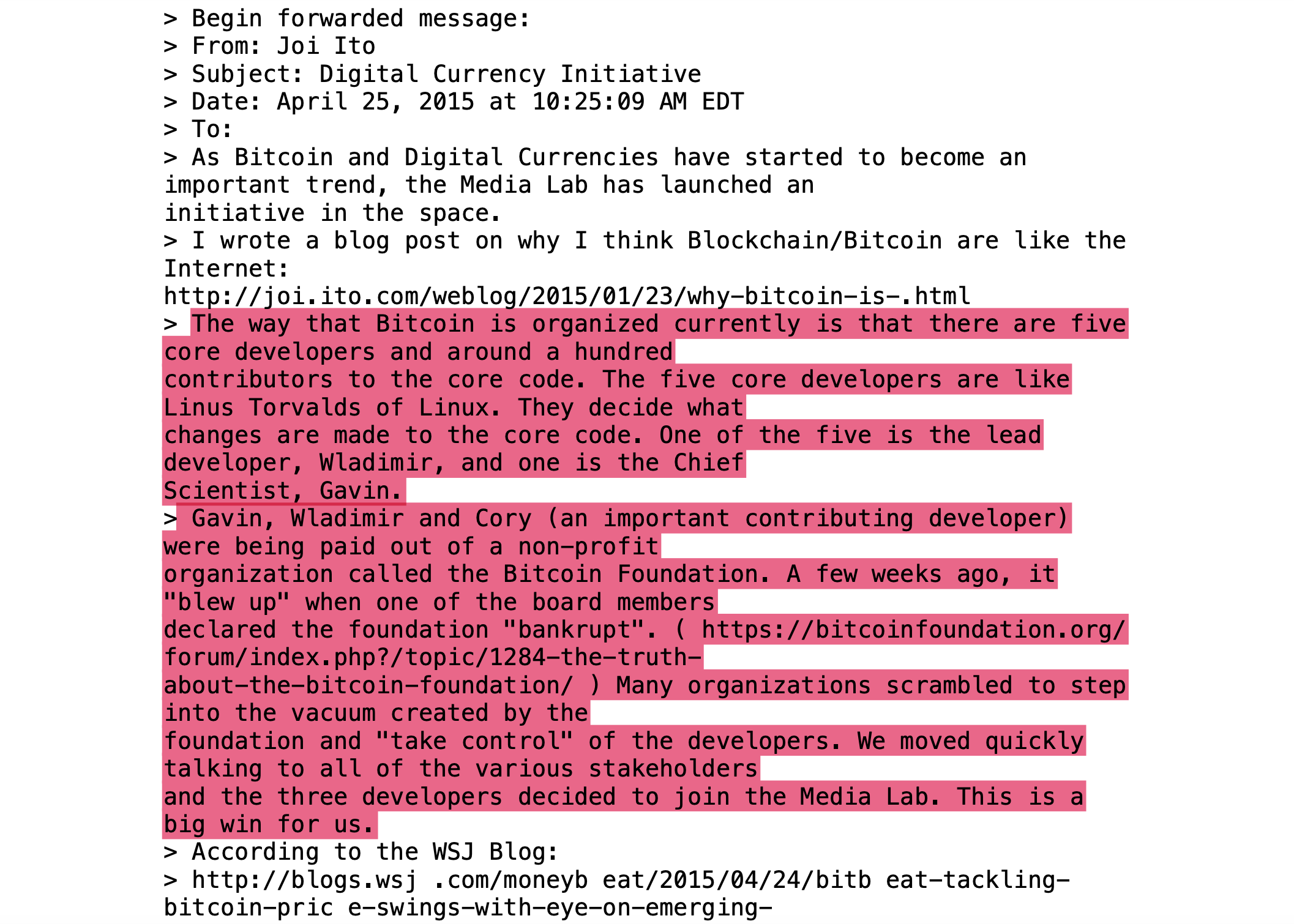
The rest of the email contains a forwarded message, in which Ito describes the success of the founding of DCI and describes the opportunity to swoop in after the collapse of the Bitcoin Foundation, a non-profit which previously served as a main donor to Bitcoin Core contributors.
“The way that Bitcoin is organized currently is that there are five core developers and around a hundred contributors to the core code. The five core developers are like Linus Torvalds of Linux. They decide what changes are made to the core code. One of the five is the lead developer, Wladimir, and one is the Chief Scientist, Gavin,” the message Ito forwarded to Epstein reads, likely referring to Mara van der Laan and Cory Fields.
“Gavin, Wladimir and Cory (an important contributing developer) were being paid out of a non-profit organization called the Bitcoin Foundation. A few weeks ago, it ‘blew up’ when one of the board members declared the foundation ‘bankrupt’,” the forwarded message explained. “Many organizations scrambled to step into the vacuum created by the foundation and ‘take control’ of the developers. We moved quickly talking to all of the various stakeholders and the three developers decided to join the Media Lab. This is a big win for us.”
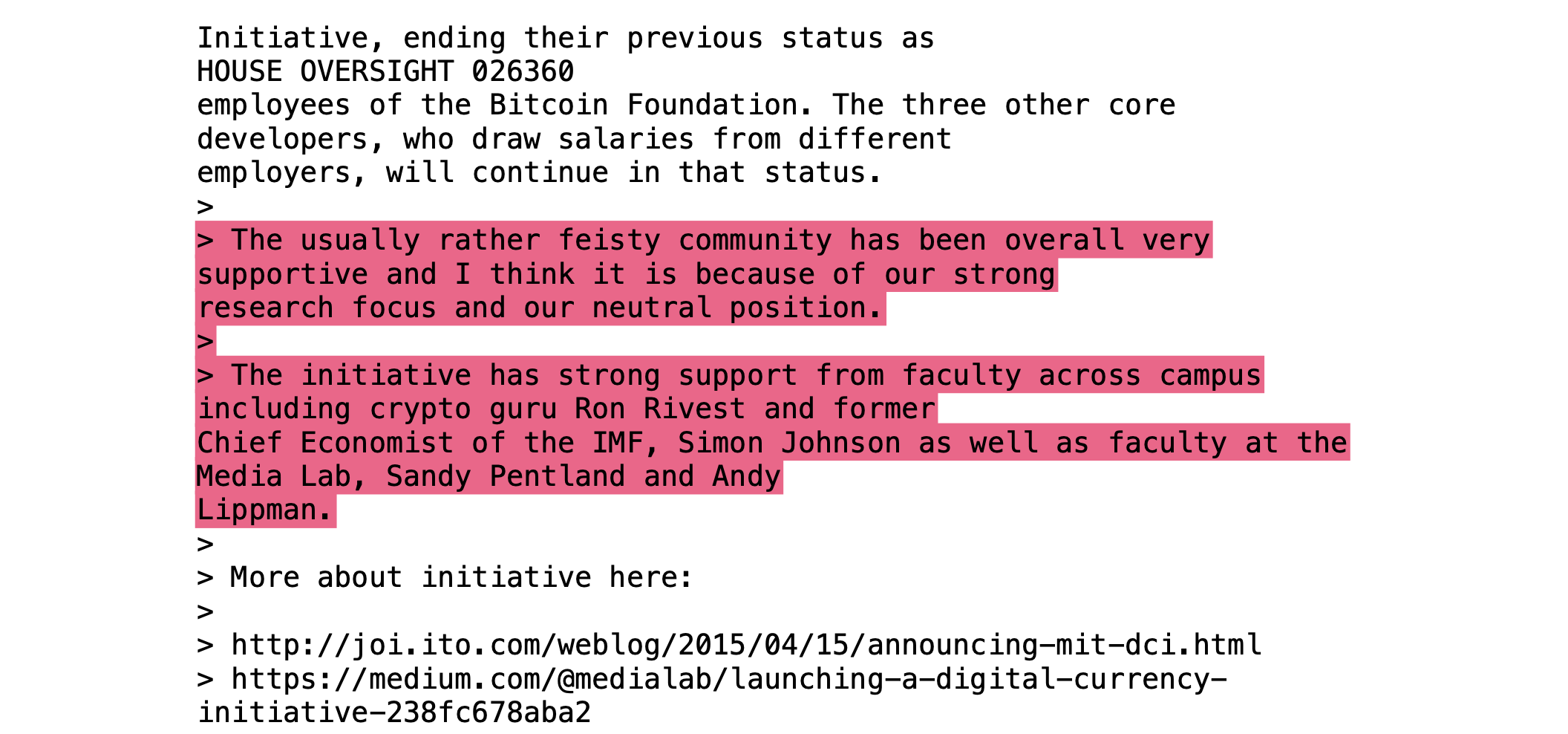
“The usually rather feisty community has been overall very supportive and I think it is because of our strong research focus and our neutral position. The initiative has strong support from faculty across campus including crypto guru Ron Rivest and former Chief Economist of the IMF, Simon Johnson as well as faculty at the Media Lab, Sandy Pentland and Andy Lippman,” the forwarded message added.
“gavin is clever,” Epstein responded to Ito.
"I didn't know about this," Van der Laan tells The Rage, adding that DCI funding is not very transparent, "definitely not back in the day," while highlighting that DCI funding comes "with no strings attached whatsoever." Fields did not respond to a request for comment in time for publication.
Prior to declaring bankruptcy, the Bitcoin Foundation saw mass resignations over the confirmation of former child actor and co-founder of the Digital Entertainment Network (DEN) Brock Pierce as its Director. In the early 2000s, Pierce and his DEN co-founders Mark Collins-Rector and Chad Shackley faced lawsuits by former underage employees who accused the three of rape, assault and death threats. In 2000, DEN co-founder Mark Collins-Rector was criminally indicted by a New Jersey federal grand jury on five counts of transporting minors across state lines for the purpose of sexual exploitation.
While Pierce has been known as an associate of Epstein, the House Oversight Committee emails indicate that Epstein specifically discussed Bitcoin with Pierce in his Manhattan home as early as 2015.
Epstein Associate Leon Black Confirmed as Media Lab Donor
At the center of Ito’s resignation from MIT Media Lab stood the private equity investor Leon Black, who was suspected of having made an anonymous $5 million donation to the institution.
At the time, Black confirmed that he had donated to Epstein “affiliated” charities in scope of his philanthropy, but did not comment on whether he was really behind the anonymous donation to MIT, or whether the donations were made on behalf of Epstein.
Emails released by the House Oversight Committee now reveal Black did in fact make donations to the Media Lab, and suggest that Epstein arranged for Black’s donations.
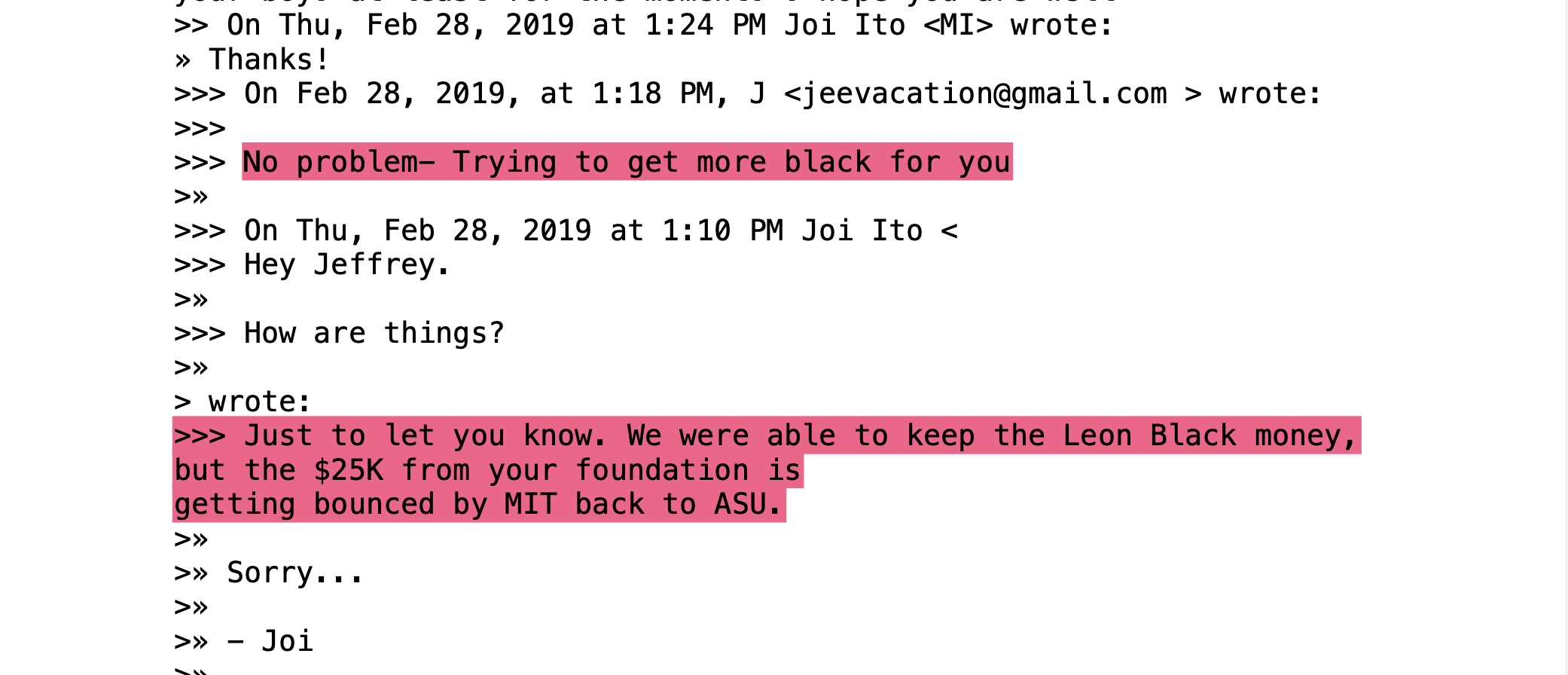
“Just to let you know. We were able to keep the Leon Black money, but the $25K from your foundation is getting bounced by MIT back to ASU,” Ito wrote to Epstein in February 2019. “No problem- Trying to get more black for you,” Epstein responded.
Leon Black is the former CEO of Apollo Capital and Epstein associate who stepped back from his position following allegations that the private equity investor paid Epstein $158 Million for financial advice. At Apollo, Black was succeeded by former SEC Chairman Jay Clayton, who currently serves as the United States Attorney of the Southern District of New York, which has become infamous within the digital currency space over its prosecutions of the privacy projects Samourai Wallet and Tornado Cash.
In 2017, MIT clarified its policy to limit anonymous donations to manage reputational risk. “Let’s assume that eventually everything becomes public, one way or another,” MIT Senior Vice President and Corporation Secretary Greg Morgan wrote in response to Ito asking whether the institution would accept anonymous donations from Epstein:
“The gift is not so large that the receiving MIT unit is dependent on this donor, i.e. the amount is too much if a reasonable person might question whether MIT or the specific recipient [...] can still exercise judgment independent from the donor.”
“What does that mean in dollar amounts? As Israel [Ruiz] says, ‘We determined that number to be below $5M a year and we would be much more comfortable with anonymous and no publicity at $1 or $2 million levels.’”
The MIT Media Lab and Digital Currency Initiative did not respond to requests for comment in time for publication.
Independent journalism does not finance itself. If you enjoyed this article, please consider making a donation. If you would like to note a correction to this article, please email corrections@therage.co